
If you work in support engineering, Site Reliability Engineering (SRE), DevOps, or any technical leadership role, you already know the feeling. The dashboards look green, the all-hands slides are full…
 Aug 23, 2026
 TrenchOps: The IT Support Engineering Blog for People Who Actually Run the Systems
Most technology writing is produced by people who have never been on a bridge call at 3 a.m. explaining to a furious CTO why his peak season is on fire. TrenchOps is the opposite of that. It is a blog about IT support engineering, technology careers and software-industry management, written by a Lead Support Engineer with more than twenty years in enterprise software – first level to third level, escalation management, technical account management, program management and consulting.
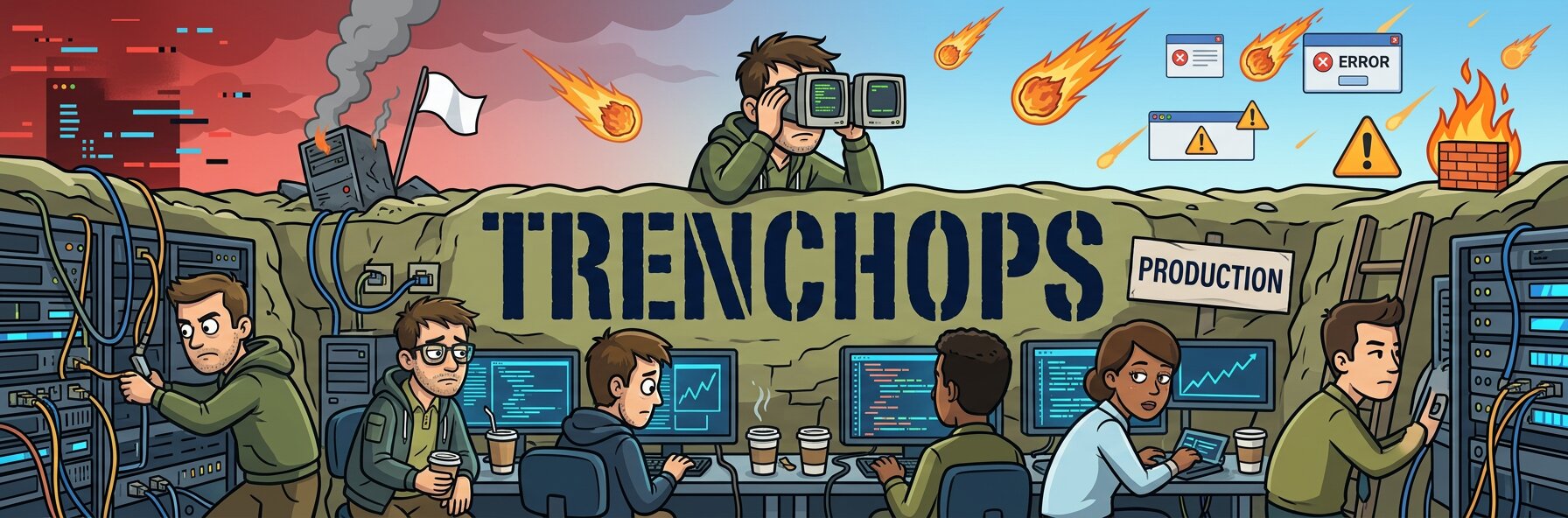
The name is not a war metaphor. “In the trenches” is the ordinary business idiom for hands-on frontline work: support queues, escalations, incident bridges, the parts of enterprise IT where the promises made in the sales deck meet the customer’s actual environment. TrenchOps means operations in those trenches.
If you have ever been the person who knew the outage was coming, said so in a weekly review, and then watched the warning get laundered into a green square on an executive slide, this site was written for you.
What makes it different from the usual tech blog
Three things, and they are worth naming because they are what makes the archive worth reading rather than skimming.
It is written from the receiving end. Most leadership content is written by leaders about leadership. TrenchOps is written by someone who spent two decades absorbing the consequences of leadership decisions and then moved far enough up the chain to see how those decisions were made. That vantage point produces uncomfortable, specific observations rather than LinkedIn aphorisms.
Every post is a mechanism, not a mood. The recurring move is to take a workplace phenomenon everyone recognises emotionally and give it a physical or economic mechanism. Bad news behaves like heat, losing energy through every management layer it passes. Technology grudges behave like hysteresis: your opinion of a vendor is a cached value with no TTL. Poverty is a friction tax that makes escape velocity harder the lower you start. Once you have the mechanism, you can act on it.
Power horses. 🐎 That is the site’s term for the dependable engineers who quietly carry a team’s load – the people who keep customer issues moving, document what they learn, and get rewarded with more work instead of more money. A large part of the archive is about how organisations lose these people, and what individual contributors can do before they burn out.
Who reads it
The blog is deliberately aimed at three audiences at once, which is unusual and turns out to be the point.
Engineers – support, SRE, DevOps, security, architecture – looking for career strategy that goes beyond “work hard and it will be noticed.” Managers and team leads who want to build processes that survive contact with reality and keep their best people from quietly updating their CVs. And senior leadership who suspect, correctly, that middle management is filtering out the information they most need to hear.
The categories worth bookmarking
The archive is organised into five main sections, each of which works as a reading list in its own right.
- IT Support Stories & Case Studies – anonymised war stories from enterprise support. The largest category, and the best entry point if you want to know whether the writing is for you.
- Support Careers & Wellbeing – burnout, boundaries, imposter syndrome, and the structural reasons good engineers grind themselves down.
- High-Performer Career Strategies – promotion strategy, negotiation, visibility, and how to avoid becoming indispensable in the way that traps you.
- IT Management & Leadership Pitfalls – the everyday anti-patterns that quietly destroy retention, quality and revenue.
- IT Systems, Processes & Resilience – tooling, documentation, KCS, single points of failure, and why process is so often used as a substitute for a fix.
There is also a German-language edition for readers who prefer it.
Start with these articles
If you only read five, read these.
The Quiet Corporate Death Spiral – the clearest single diagnostic in the archive. When leadership answers a broken tool with a new process instead of a fix, the cost does not just add up, it compounds negatively. Includes a practical script for raising it without sounding like the office complainer: quantify the process tax in hours per week and convert it to full-time equivalents.
The Comfort Trap – why companies die of politeness. A warning that starts as “this defect will take down a major customer” arrives at the executive floor as “ongoing scalability investments.” The fix is not a courage poster, it is fewer layers and an incentive structure where hiding is the dangerous option.
The Kubernetes Guy Is About to Have a Very Bad Year – the most-shared post on the site, and the one most likely to start an argument in your team channel. The argument is not that Kubernetes is bad. It is that a career built on configuration rather than comprehension has a single point of failure, and AI just found it.
Everyone Steals – The Smart Ones Call It Learning – the AI distillation wars used as a mirror for the knowledge hoarder in your own org, from someone who spent years as a KCS Ambassador fighting exactly that. The line that lands: you cannot be promoted out of a job only you can do.
Many Eyes, Zero Readers – a hardware wallet that generated keys from a random number generator its firmware never called, for five years, with the source public the whole time. The security lesson underneath is that “auditable” is not “audited,” and that every supply-chain control you have answers provenance, not correctness.
Also worth your time: The Five-Year Dead Man’s Switch That AI Defused in Five Minutes on job security through deliberate spaghetti code, The Sunday Blues Aren’t About Sunday on the structural cause of Sunday dread, The Opinion I Cached in 2003 on giving your technology opinions an expiry date, and Everybody Had a Blockchain – Nobody Had a Problem on how to audit whatever buzzword is currently spiking your industry’s press releases.
Topic hubs
The tag system is a faster route in if you have a specific interest. The most active hubs are AI, Career, Management, Retention, Documentation, Knowledge Management, Neurodivergent, InfoSec and Corporate Culture.
Neurodivergence gets more serious treatment here than on most industry blogs, including dedicated pieces on autism in the workplace and ADHD in the office – written as talent strategy rather than as a diversity checkbox.
Frequently asked questions
Is TrenchOps about the military?
No. “In the trenches” is a standard business idiom for hands-on frontline work. TrenchOps covers IT support, technical operations and enterprise software careers.
What is a “power horse”?
The site’s term for the dependable high performers who carry a team’s workload – and who are usually rewarded with more work rather than more money. Retaining them is a recurring theme.
Who writes it?
A Lead Support Engineer with 20+ years in enterprise software, across first- to third-level support, escalation, technical account management, program management and consulting. The about page has the full background.
Is it only for support engineers?
No. The audience is engineers of all stripes, team leads, and senior leadership who want visibility into what middle management filters out.
Where to start
If you manage people, start with IT Management & Leadership Pitfalls. If you are an engineer trying to work out your next move, start with High-Performer Career Strategies. If you just want to know whether the writing earns your time, start with the stories and give it one post.
New articles land several times a week. There is an RSS feed for anyone who still runs a reader, and a welcome post that lays out what the site is trying to do.
Field notes for the engineers, managers and leaders who keep enterprise software running: trenchops.com